
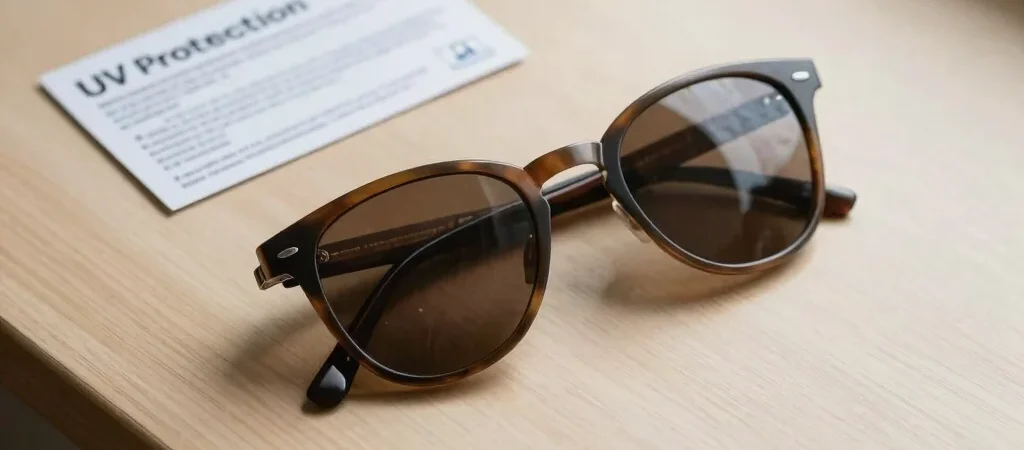
Two pairs of sunglasses can look equally dark on a shop shelf and offer very different information about ultraviolet protection. Tint changes how much visible light reaches your eyes; it is not, by itself, proof of UV protection. Start with the lens label or product documentation, not the shade of the lens.
Look for clear UV wording
Look for wording such as “100% UVA/UVB protection” or “UV400,” and check that it refers to the lenses rather than appearing as a vague claim about the whole frame. If the information is missing or unclear, ask the retailer or manufacturer for documentation before relying on the glasses for sun exposure. A label is useful guidance, but the claim still needs a clear source.
Tint and protection differ
A very dark tint may make a bright afternoon feel more comfortable, but darkness alone does not establish how much ultraviolet radiation a lens blocks. Conversely, a lighter lens can still be described as offering UV protection if it has the appropriate specification. Treat comfort and UV information as two separate questions when comparing lenses.
Choose for the setting
Think about where you will wear the glasses: a walk on a bright pavement, time near water, or a drive can involve different glare and visibility needs. Polarized lenses can reduce reflected glare, but polarization is not a substitute for checking UV protection, and screens may be harder to read through some polarized lenses. Before choosing, confirm the UV wording, consider the conditions you face, and try the lenses in the situations that matter to you.